design & research
PromptOps: A Multimodal Tactical AI Interface for Faster Field Decisions
Role: UX Researcher, UX Designer, Concept Strategist
Timeline: March 2025 - June 2025
Tags: Defense UX, Multimodal Interaction, AI Concepts, Human Factors, Cognitive Load Reduction
Tools: Figma, Adobe Photoshop, UX Research, System Mapping, UX Writing, Scenario Design, AI Design
Detail: A DARPA ERIS concept exploring how voice, text, and touch-based AI interactions could improve speed, clarity, and usability in tactical field operations.
Overview
PromptOps - AI Assistance for Faster Decisions at the Tactical Edge

UI Concept: Push-to-talk voice capture enables medics to log urgent evacuation details hands-free without leaving the map view.

PromptOps is a concept for a multimodal tactical assistant designed to reduce cognitive load for military personnel operating in fast-moving, high-pressure environments. Rather than introducing new hardware, the idea focuses on improving how operators interact with the rugged phones, tablets, and field laptops they already use.
Originally developed as a submission to DARPA’s ERIS program, PromptOps was envisioned as an on-device software layer that could integrate with systems such as ATAK (Android Team Awareness Kit, a battlefield coordination and mapping platform), Nett Warrior (a dismounted soldier situational awareness system), and other tactical communication tools already used in the field.
The core idea is simple: instead of forcing soldiers, medics, and operators to dig through menus, type reports, or switch between radios and screens, PromptOps would let them interact through push-to-talk voice input, short text commands, and simple touchscreen gestures. That shift aims to support faster action, clearer communication, and more heads-up awareness in situations where attention is limited and seconds matter.
Problem
Current Tactical Systems Still Create Too Much Friction
Modern military teams already use digital tools to coordinate missions, track positions, share intelligence, and document field activity. Systems like ATAK and Nett Warrior have improved situational awareness, but the interaction model is still largely manual, visually intensive, and slow under pressure.
In practice, this means operators often have to split attention between the mission in front of them and the device in their hands. A medic may need to treat a casualty while logging notes. A drone or ISR operator may need to route information quickly without digging through layers of interface. A JTAC or battlefield weather specialist may need time-sensitive data without stopping to navigate menus.
This creates a recurring problem: too many critical tasks still depend on screens, manual input, and fragmented tools such as radios, maps, and field tablets. The result is increased cognitive load, slower decisions, and reduced situational awareness at the exact moment speed and clarity matter most. The research behind PromptOps framed this as a shift away from “heads-down, hands-full” interaction and toward a more “heads-up, hands-free” model.
PromptOps was created in response to that gap: not to replace existing tactical systems, but to make them faster, more intuitive, and easier to use in the field.

This positioning chart shows how PromptOps reduces interaction burden while enabling faster decision-making than existing tactical tools.
Solution
A Multimodal AI Layer Built for Existing Field Devices
PromptOps is designed as an on-device tactical assistant that runs on the rugged smartphones, tablets, and field laptops already used in military operations. Rather than replacing current systems, it adds a faster interaction layer on top of them—making tools like ATAK, Nett Warrior, and related field software easier to use when time and attention are limited.

Large touch targets allow operators to trigger multi-step actions with a single gesture instead of navigating layered menus.
The system is built around three lightweight input methods:
-
Push-to-talk voice input for fast spoken commands
-
Short text prompts for quiet or high-noise conditions
-
Simple touchscreen gestures like tap, swipe, and press to confirm or trigger actions
Behind those inputs, PromptOps uses small, task-focused AI models designed for specific operational needs such as ISR, medical logging, and battlefield coordination. Instead of a general-purpose assistant, the concept focuses on narrow, useful actions: summarizing information, formatting reports, retrieving relevant data, and helping users move faster through existing workflows.
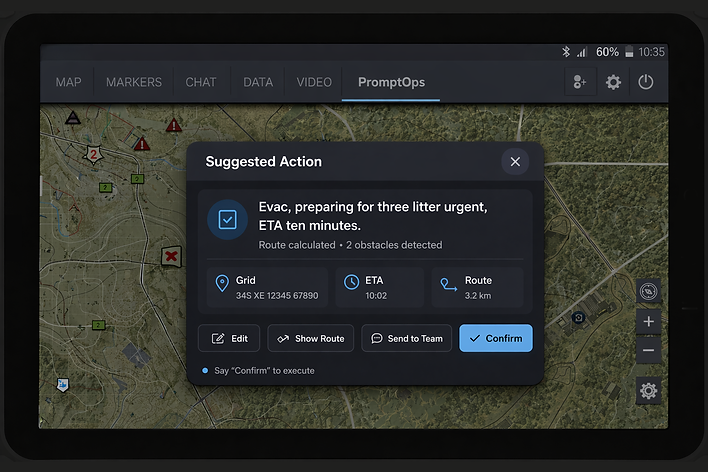
Suggested actions turn spoken or typed input into a structured next step, giving operators a fast path to review, edit, and confirm execution.
Just as important, the concept was designed for offline-capable, on-device use. That means processing would happen locally on the device rather than depending on constant cloud access - an important constraint in tactical environments where connectivity may be limited, contested, or unavailable.
In short, PromptOps is not a new gadget. It is a practical software concept: a multimodal AI interface intended to reduce friction on the devices operators already carry.
How It Works
Turning Natural Input Into Faster Tactical Actions
PromptOps is designed to simplify tasks that currently require multiple steps across radios, touchscreens, and field software. Instead of navigating menus or formatting information manually, the operator gives a short command and the system translates that intent into a structured action.
A typical interaction would follow this flow:
-
The operator gives input using push-to-talk voice, a short text command, or a simple touchscreen gesture.
-
PromptOps interprets the request through lightweight, role-specific AI tuned for tasks such as ISR support, medic documentation, or battlefield coordination.
-
The system returns an actionable result such as a summarized answer, a structured log entry, a suggested next step, or a routed update to the appropriate team or tool.
For example, instead of manually opening an app, finding the right form, entering details, and transmitting the update,
-
A field medic could dictate a treatment note and have it automatically formatted and prepared for sharing.
-
A drone operator could issue a short prompt to identify and tag relevant activity.
-
A JTAC or weather analyst could quickly request environmental data without stopping to work through interface layers.
The interaction model is intentionally adaptive. If voice is impractical because of noise, privacy, or reliability, the same task can shift to short text input or touchscreen shortcuts. That multimodal fallback is a key part of the concept: the system is meant to adjust to field conditions rather than force one rigid method of use.
At a UX level, the goal is straightforward: reduce the number of steps between intent and action so operators can stay focused on the mission, not the interface.

This flow illustrates how PromptOps translates voice, gesture, and text input on existing field devices into immediate actionable output.
Who It Serves
Designed for Roles Where Speed, Clarity, and Attention Matter
PromptOps was shaped around tactical roles that already depend on digital systems but still lose time to manual input, fragmented communication, and interface friction. Rather than designing for one narrow workflow, the concept focuses on operators who need fast access to information without breaking focus.

Field Medics
Medics often need to document injuries, treatments, and patient status while actively providing care. In current workflows, that can mean shifting attention to a screen, typing notes, or relaying updates through radio. PromptOps was designed to let them quickly log and send structured information through voice or simple confirmation gestures while keeping hands and attention on the patient.

Drone / ISR Operators
ISR stands for Intelligence, Surveillance, and Reconnaissance. These operators monitor live feeds, identify threats, and guide units using visual and location-based information. Their challenge is not a lack of data, but the speed and complexity of acting on it. PromptOps was intended to help them query, tag, and share relevant information faster without digging through multiple interface layers.

JTACs and Battlefield Weather / Coordination Roles
A JTAC is a Joint Terminal Attack Controller, a role responsible for coordinating air support in dynamic environments. These users rely on precise environmental and situational data, often under intense time pressure. PromptOps was designed to reduce the steps required to retrieve that information and route it clearly to the people who need it.
Across all three roles, the common design challenge is the same: how to reduce interaction burden on tools that are already essential, but still too slow and demanding when the situation becomes critical. PromptOps approaches that problem by giving users a faster way to communicate intent across the systems they already use.
Scenarios In Action
Applying PromptOps in High-Pressure Workflows
To test the concept, PromptOps was mapped against three tactical scenarios where operators must process information quickly while balancing multiple tools and responsibilities. Each scenario focused on reducing the steps between input, interpretation, and action.
Field Medics
A medic treating a casualty may need to record injuries, log treatment, and send updates to evacuation teams at the same time. PromptOps was designed to let the medic use push-to-talk voice input to dictate a treatment update, automatically convert it into a structured record, and confirm sharing with a simple touch interaction. This reduces documentation friction without interrupting care.

Drone / ISR Operators
A drone or ISR operator may need to identify a threat, mark it, and share that information quickly with nearby units. PromptOps was designed to support short natural-language prompts that summarize, tag, and route relevant data faster than a fully manual workflow. The goal is to reduce delay between observation and response.

JTACs and Battlefield Weather / Coordination Roles
A JTAC or battlefield weather analyst may need rapid access to wind, terrain, or visibility information before coordinating support. PromptOps was designed to retrieve that information through a short command and return it in a concise, usable format, with the ability to forward it immediately through existing systems.
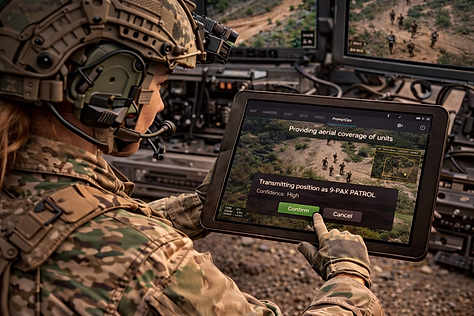
Across these scenarios, the value of the concept is not in replacing tactical judgment. It is in reducing interface friction so users can act faster on the systems and information already available to them.
Impact & Future Potential
Reducing Friction on Systems Already in Use
PromptOps was developed around a practical idea: improving tactical performance does not always require new hardware. A meaningful gain can come from making existing devices easier and faster to use under pressure. The concept was positioned specifically as software that could work with current rugged tablets, phones, and field laptops rather than requiring new equipment purchases.
Its projected value comes from three areas:
-
Lower cognitive load by reducing manual entry, menu navigation, and fragmented interaction across tools.
-
Faster decision support by turning voice, text, or gesture input into structured actions and summarized outputs.
-
Greater operational realism by keeping processing on-device and designing around existing military platforms and workflows.
Although PromptOps was originally framed for defense use, the underlying design logic has broader relevance. The same UX problem appears anywhere users must operate quickly while juggling digital tools, communication demands, and real-world risk. That makes the concept expandable to future contexts such as emergency response and other high-stakes field operations, while remaining grounded in its original tactical purpose.
PromptOps ultimately became a study in designing for the tactical edge: not by adding complexity, but by reducing the number of steps between human intent and meaningful action.

This flow illustrates how PromptOps translates voice, gesture, and text input on existing field devices into immediate actionable output.